

Universal Design
New Zealand has accomplished extraordinary things in architecture over the last decade – and yet many of our built environments are unsafe and bewildering for users.
Take Auckland: despite being hailed as New Zealand’s most developed city, it’s riddled with uneven surfaces, sharp drops, stairs, confusing intersections – dangerous terrains that are ill-suited to elderly, visually impaired, wheelchair-bound, and mobility restricted people.
These environments are designed for the ‘average’ person, and all other needs are addressed as an afterthought. As a result, vulnerable people are forced to adapt to unfriendly spaces at great personal expense, or to withdraw from the environment entirely.
The remedy is simple: universal design, or the creation of environments that are inclusive and supportive of human diversity. This is our way forward from the mistakes of the past; this is the mindset shift that has already resulted in some of the best new buildings of the twenty-first century.
Here’s how to put it into practice.
One Bite at a Time
There’s an old saying that goes, ‘there’s only one way to eat an elephant – one bite at a time.’
The architecture industry is complex and challenging, so let’s not overcomplicate things by deep diving into the theory of universal design.
Instead, we’ll focus on some practical steps you can take to improve your environment.
- Pay attention to how your building talks
Your environment constantly communicates with the people who use it, conveying information such as important locations and routes of transit. However, not everyone communicates in the same way, so you should enhance your design with multisensorial communication cues.
For example, if there’s a step or a platform in your flooring, then you’re probably already communicating this to people through caution signs. However, a visually impaired user might not be able to see this signage. A non-English-speaker may not be able to read it. And let’s face it: a lot of people walk around without really paying attention to things.
This is where you need tactile indicators.
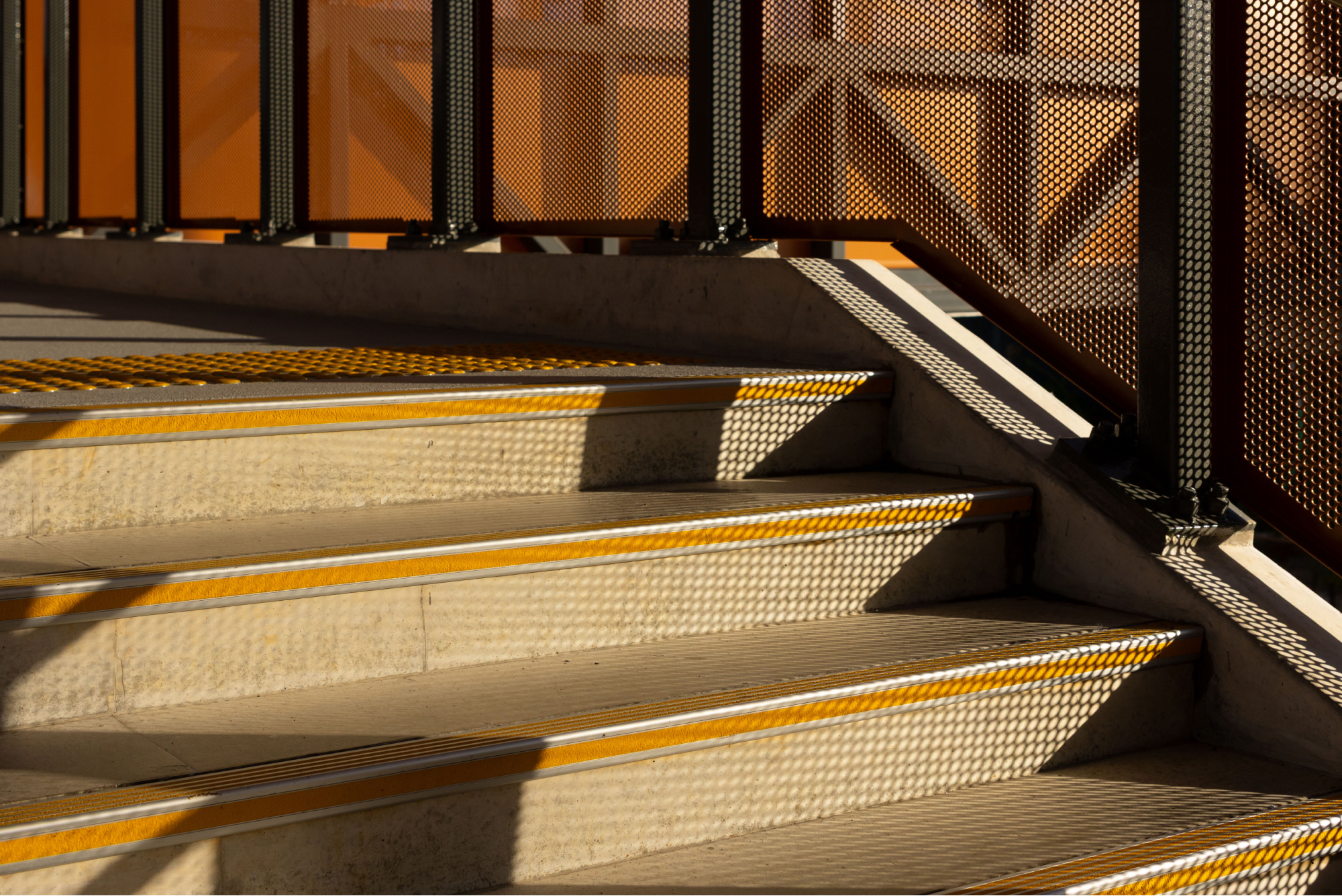
Tactile indicators are studs or bars installed into flooring to warn people of changes in their surroundings. When someone walks onto a tactile indicator and feels the pattern underfoot, it calls their attention to their surroundings, helping them to notice hazards. These cues are especially important for visually impaired people; the type and pattern of the indicator express a lot of information about safe and unsafe pathways. - Invest in accident prevention
For people with mobility impairments, travelling within an environment can quickly become a stressful ordeal. Imagine trying to walk down a wet wooden ramp while you’re wearing a moonboot for an ankle injury; imagine trying to descend a staircase when your joints don’t bend easily. Not only do these people face a higher risk of injury, but there’s the additional strain of anxiety and discomfort.
As an architect, you can address these fears by safety-proofing your environment. Reduce slip risks by installing stair inserts and stair nosing on your staircases; cut down on slipperiness with the use of walkway inserts. These modifications are so simple, and yet so effective; just a few well-designed strips of carborundum or stainless steel might be all you need to prevent a fall. - Design for worst selves
Vehicular and machinery zones are high-risk environments where a single mistake can translate into catastrophic damage.
On a good day, people are kind and patient and attentive to their surroundings – but people often have bad days too, and we need to account for this in our designs.
We can’t stop people from speeding, but we can use speed humps and safety cushions to slow them down. We can’t keep people from parking or reversing carelessly, but we can use safety bollards to contain collision impacts. People make mistakes. With a few simple modifications, we can minimise the fallout and create a far more forgiving environment.
Know when to ask for help
The premise behind universal design is so simple: it’s just about compassionate, people-centric architecture. Yet sometimes it can be hard to know if you’re making the right call.
For example, what if you want to install tactile indicators, but you’re worried that they’ll impair wheelchair accessibility? Or how about if you’re looking into stair nosings, but you can’t find anything that matches your cultural narrative and design scheme.?
This is where you can get in touch with accessibility organisations like Blind and Low Vision New Zealand, or with suppliers like Freedom Works. Remember, this isn’t a solo mission; it’s a group project. We’re proficient in code-compliant safety and accessibility detailing, so let us streamline your decision-making process.